
By Antal Kuthy
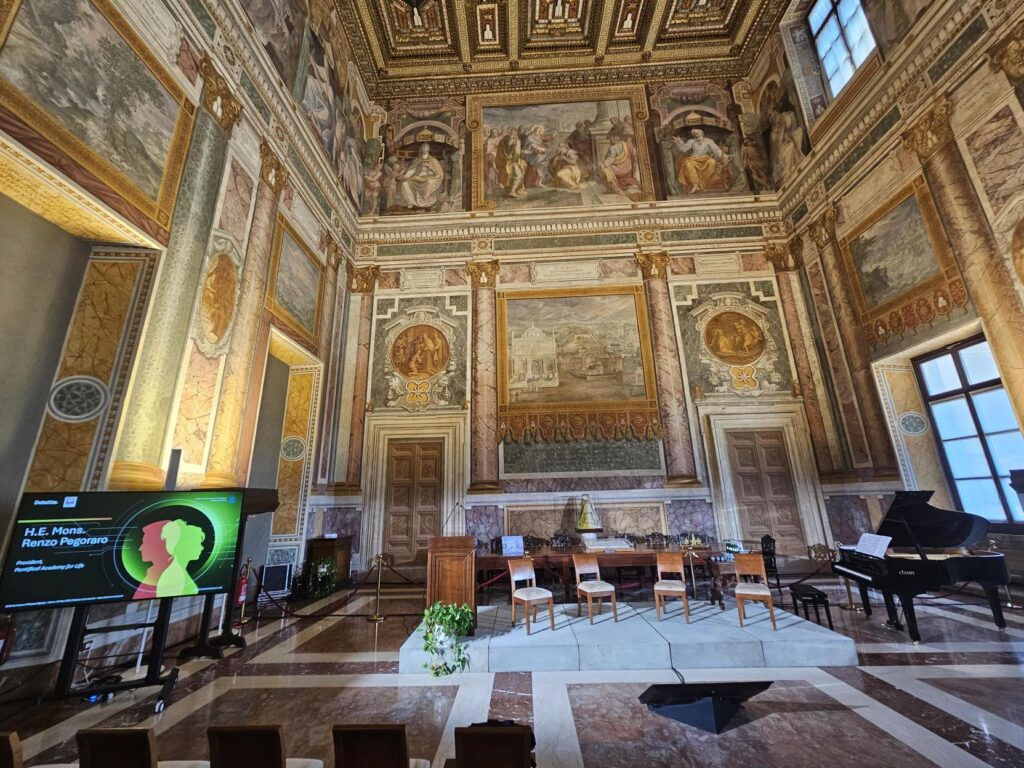
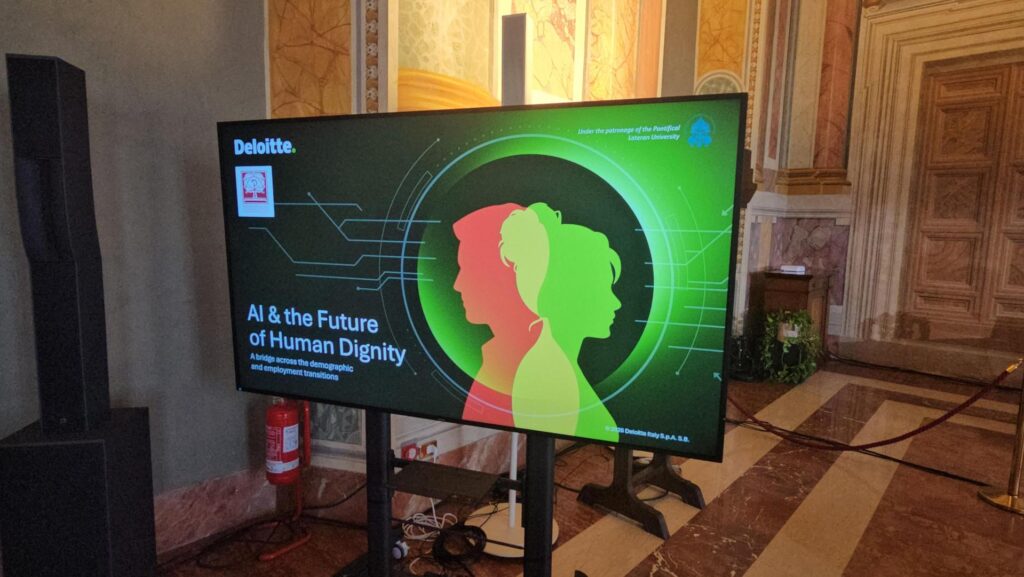
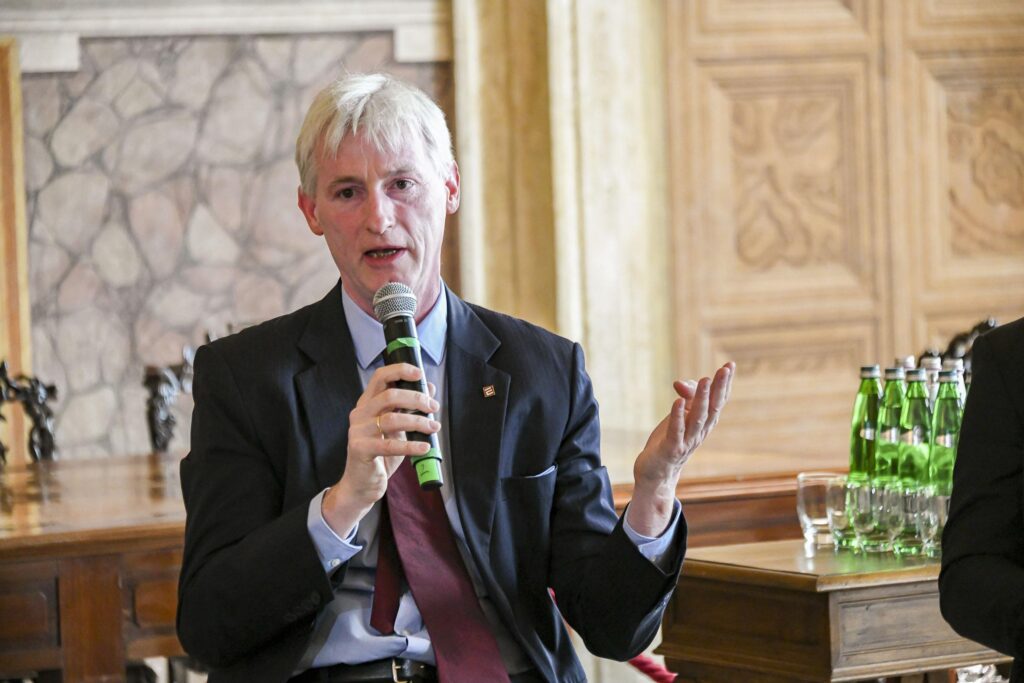
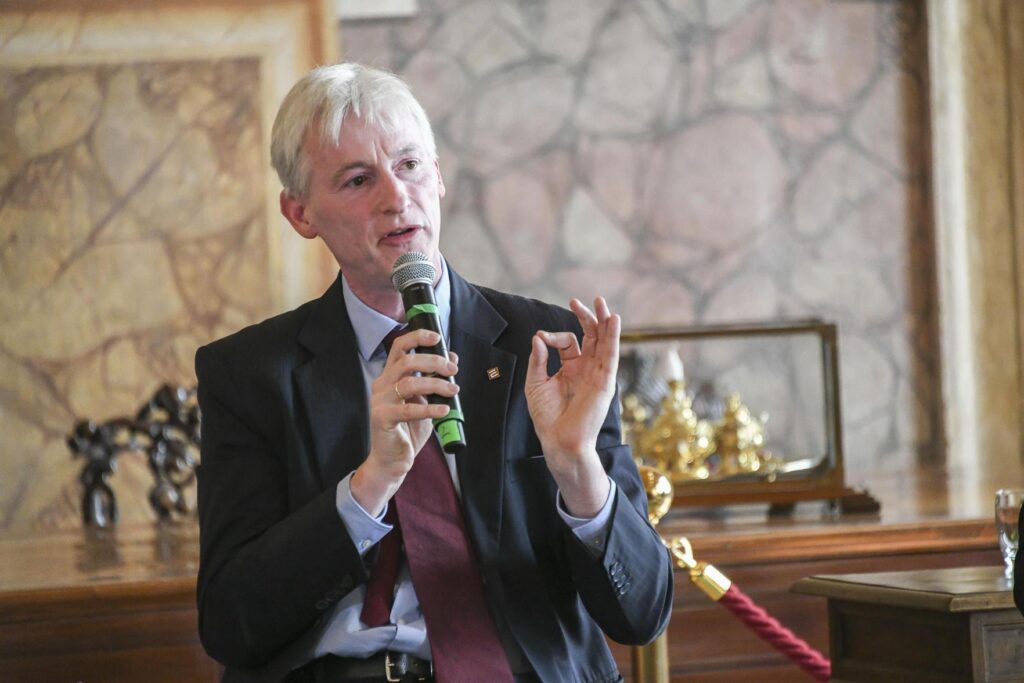
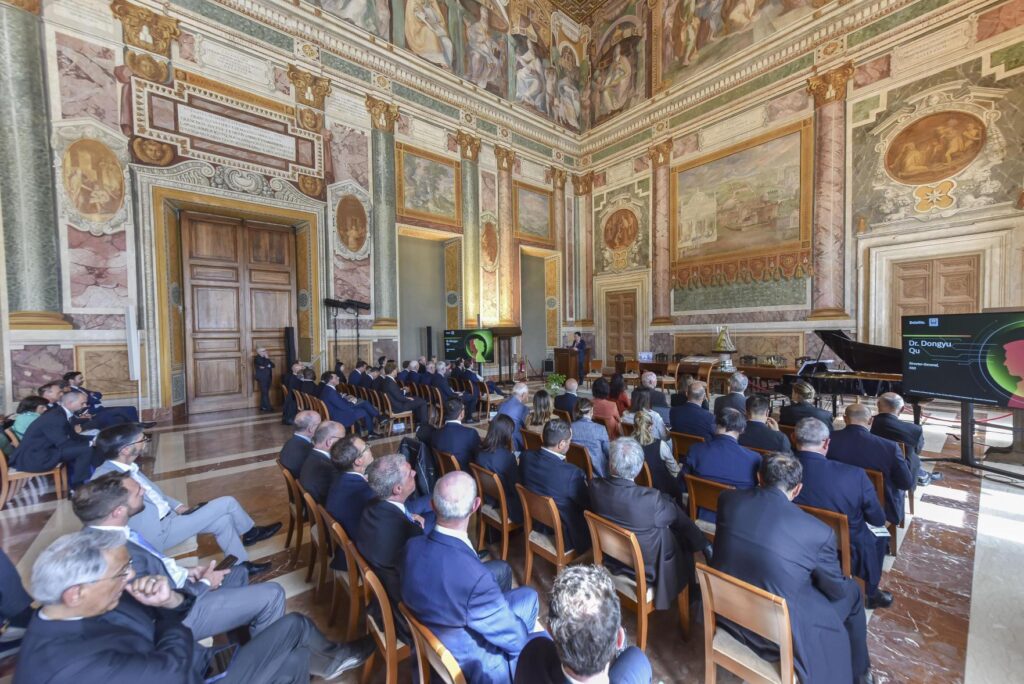
On May 25, 2026, the Pontifical Academy for Life, represented by Chancellor Monsignor Renzo Pegoraro, hosted the symposium “AI & the Future of Human Dignity” in Rome. Amidst a distinguished gathering of global leaders and technologists, Antal Kuthy took part in a panel discussion, sharing his perspective on Europe’s technological future.
The symposium featured a panel discussion on “Governance, Capital and Development Models” in which Antal Kuthy participated as a respondent alongside Jaques Moscianese, Group Head of Institutional Affairs at Intesa Sanpaolo, and Fr. Michael Quaicoe, Director of Governance, Justice and Peace at the Ghana Catholic Bishops’ Conference. The keynote was delivered by Hon. Brando Benifei, Member of the European Parliament, and the session was moderated by Zoltán Papp, Co-Founder of Falkon Ventures.
At the symposium “AI & the Future of Human Dignity” in Rome, hosted by the Pontifical Academy for Life in partnership with Deloitte Central Mediterranean; Vatican leaders, a Nobel Peace Prize laureate, leading scientists, EU AI Act legislators, UN representatives, ethicists, and technology industry leaders gathered to discuss the ethics, labor impacts, and the future of human dignity in the age of artificial intelligence.
In this context, I argued that Europe stands at a decisive civilizational crossroads in the age of AI.
Reclaiming human intelligence
I initially elaborated my key message: that when we speak about artificial intelligence, we must first listen to our heart and soul. We cannot blind ourselves and pretend that the current way AI is built, governed, and distributed is something humanity truly feels comfortable with. On the contrary, many people instinctively feel that something is not right, something is missing, something is deeply unbalanced. We must listen to that instinct. Human intelligence is extraordinarily valuable, unique, creative, emotional, spiritual, and diverse.
The key question is whether the current AI generation and distribution model truly enriches human intelligence and helps humanity become wiser, more creative, and more fulfilled. Today, we are increasingly living inside what I described as a highly addictive infrastructure. The current centralized AI ecosystem and its dominant business model increasingly display the characteristics of a parasite rather than a symbiotic system: every incremental contribution feeds centralized intelligence while gradually devaluing human originality, uniqueness, and independent thought.
The more we contribute, the more homogenized we risk becoming. At the extreme, humanity risks becoming intellectually and spiritually empty. This must change. Technology must answer to people, not the other way around.
The case for strategic autonomy
I also argued that Europe must stop seeing itself merely as a consumer of foreign technology and rediscover itself as a sovereign technological power. Europe must recognize itself as what it already is: a superpower. This is not an aspiration or political slogan, but part of Europe’s identity and self-definition. With its industrial base, scientific depth, regulatory influence, economic scale, cultural heritage, and democratic traditions, Europe already possesses the foundations of a global power.
The mistake has been to approach technology primarily through the lens of market regulation and competition policy, while other powers treat AI, data, cloud infrastructure, digital identity, energy, and compute as strategic assets. Europe must do the same. Public procurement should become a strategic instrument to strengthen sovereign European technological capabilities and create industrial momentum. At the same time, while Europe rebuilds elements of full sovereignty, it should pursue a strategy of strategic autonomy: not defining permanent enemies, but remaining consistently pro-European, intelligently balancing and combining external technologies, resources, and capabilities in ways that preserve European independence, leverage, and long-term freedom of action.
Today, most AI capabilities, cloud infrastructure, and digital intelligence layers are controlled outside Europe, creating not only economic dependence but also legal, ethical, and epistemic vulnerability. European data, institutions, and even public discourse increasingly rely on systems governed by non-European interests and laws.
Decentralization and the principle of subsidiarity
I emphasized that “sovereignty of intelligence” is not isolationism, but the ability for Europe to retain control over its data, infrastructure, models, values, and regulatory enforcement. AI should evolve toward decentralized, federated, and human-centric architectures rather than hyperscaler monopolies that risk turning intelligence into what I called an “addiction infrastructure.”
A major theme was subsidiarity, the European principle that decisions should be made at the lowest competent level. Applied to AI, this means SMEs, institutions, and communities should be able to deploy sovereign AI infrastructure without surrendering their data or intellectual capital to centralized platforms. Europe should build shared foundational infrastructure at EU level, while enterprises retain ownership of their intelligence, workflows, and strategic knowledge.
Practical steps for Europe
I also outlined practical steps Europe can take in the next 24 months: deploying sovereign cryptographic and identity frameworks, accelerating sovereign cloud and AI initiatives such as IPCEI-CIS, enforcing the AI Act in a strategically coherent way, and using procurement and industrial policy to strengthen European technological autonomy.
Finally, I stressed that faith-based and civil institutions have a profound role to play. They are not merely observers of the AI transition, but guardians of human dignity, ethical plurality, cultural memory, and public trust. Europe already possesses the scientific, industrial, regulatory, and moral foundations of a true superpower, what is needed now is courage, coordination, and the will to build.
About the symposium: https://www.vaticannews.va/es/vaticano/news/2026-05/pegoraro-la-ia-no-puede-decidir-por-si-sola-lo-que-es-justo.html
About Magnifica Humanitas: https://www.vaticannews.va/en/pope/news/2026-05/pope-leo-xiv-magnifica-humanitas-presentation-ai-disarmament.html
Header image source: Wikipedia, By Dnalor 01 – Own work, CC BY-SA 3.0 at